Is your business close to the S$1 million GST registration threshold?
Many business owners check their Profit & Loss statement and assume:
“My accounting revenue is below S$1 million, so I do not need to register for GST.”
This may not always be correct.
For GST registration, IRAS looks at your taxable turnover, which can differ from the revenue shown in your accounts.
What is the GST registration threshold in Singapore?
You may be required to register for GST if your taxable turnover:
exceeds S$1 million for the calendar year from 1 January to 31 December; or
is reasonably expected to exceed S$1 million in the next 12 months.
The second test matters when you sign a large contract, receive confirmed orders, or have accepted quotations that make future sales certain.
What is taxable turnover?
Taxable turnover includes the value of your business’s:
Local sales of goods and services subject to 9% GST;
Zero-rated supplies, such as qualifying exports and international services.
It generally excludes:
Exempt supplies, such as many financial services and residential-property rent;
Out-of-scope supplies;
Sale of capital assets, such as office furniture, machinery or equipment.
Accounting revenue and GST taxable turnover are not the same
Accounting follows the principle:
Recognise revenue when the goods or services are delivered.
GST follows a different timing rule:
For most transactions, GST is triggered at the earlier of invoice date or payment-received date.
This means money may be relevant for GST before it becomes revenue in the Profit & Loss account.
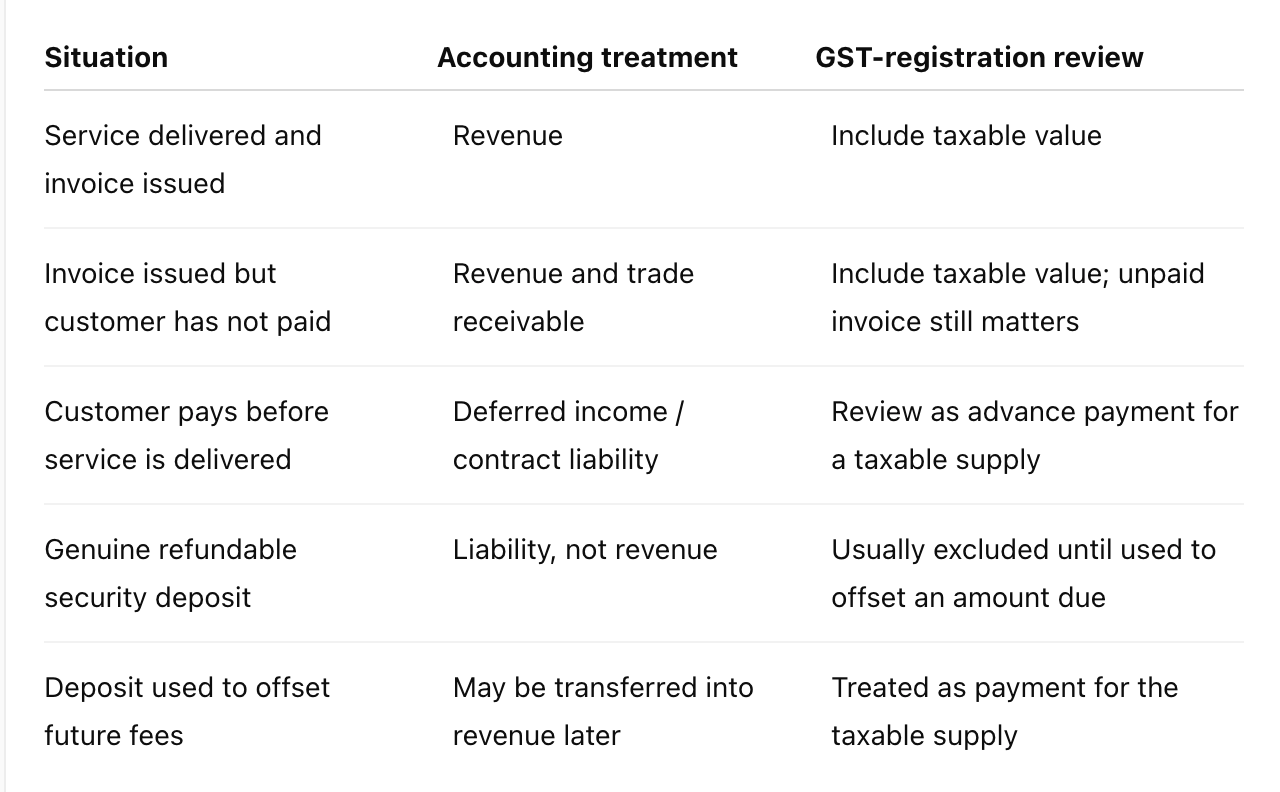
Example: Customer pays before the service is delivered
A training centre collects S$30,000 in February for a January-to-March course.
In the accounts:
- January and February lessons may be recorded as revenue;
- The March portion may remain as deferred income at the end of February.
However, the March amount is not automatically excluded from the GST-registration review simply because it is deferred income in the accounts.
The payment is for an identified taxable service. The business should track the full amount separately when monitoring GST taxable turnover.
Can the business call the March fees a “deposit” to exclude it?
It depends on what the payment really is—not what it is called.
A payment is generally an advance or partial payment if it forms part of the fee for goods or services. A partial payment deposit is subject to GST treatment when received.
A true refundable security deposit is different. It is held as security, for example against property damage or unpaid charges, and is not payment for the service unless it is later used to offset an amount due.
Therefore, a semester fee collected upfront for March lessons is usually an advance payment, not a security deposit.
What if March has not been invoiced or paid?
If the March service:
- has not been invoiced;
- has not been paid; and
- is not yet contractually confirmed or due,
it may not be included in the historical turnover calculation at that point.
However, if the business has signed contracts, accepted quotations or fixed monthly fees that make future income sufficiently certain, it may still be relevant when assessing whether taxable turnover will exceed S$1 million in the next 12 months.
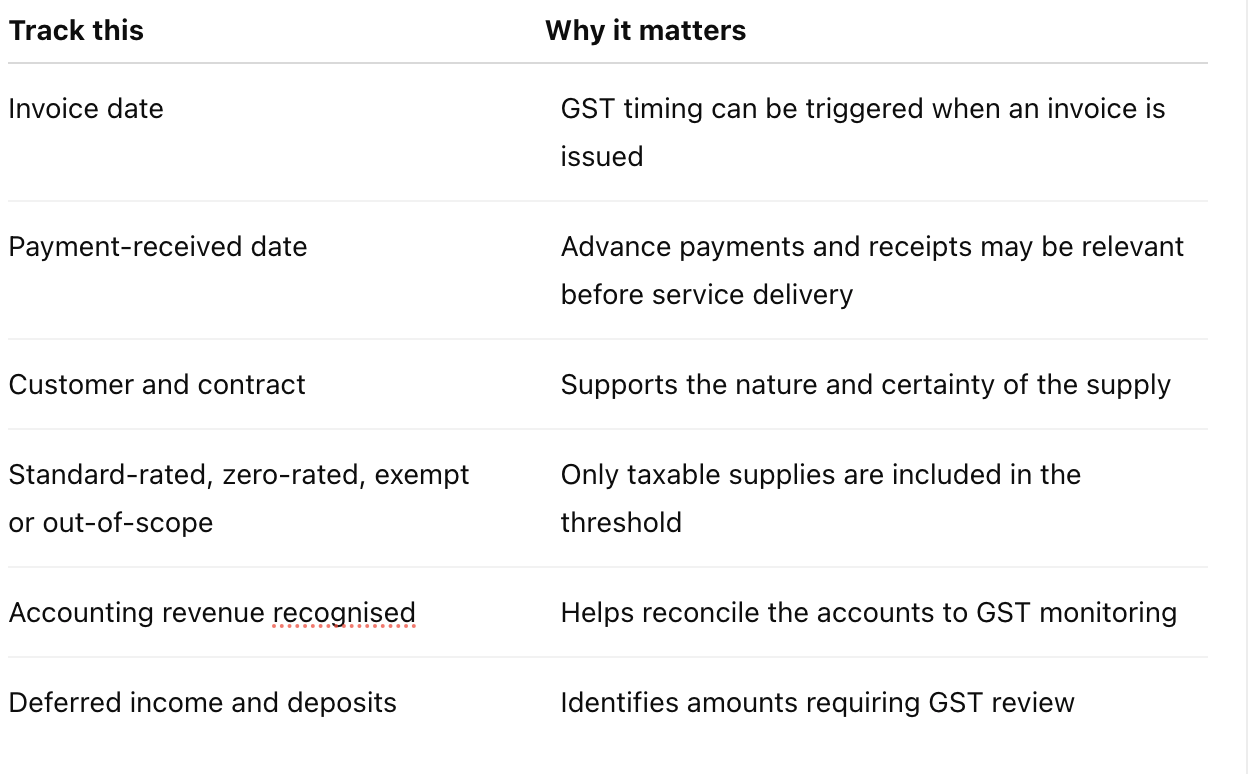
How should a business monitor GST registration liability?
Do not use the P&L revenue total alone. Prepare a separate GST taxable-turnover tracker every month.
Key takeaway
Accounting revenue answers: “How much income was earned from services already delivered?”
GST taxable turnover answers: “What taxable supplies has the business made, and is it required to register for GST?”
A business can have deferred income in its accounts but still need to review the related invoice or customer payment for GST-registration purposes.
Need help to assess your business’s GST registration risk?
Contact Accretion Consulting Pte. Ltd. for a review of your taxable turnover, invoices, advance receipts and supporting documents.